
Short Technique & Basic Grammatical 99 Rules
100 golden rules of English Grammar for error detection and sentence improvement
এই অধ্যায়ের মধ্যে English Grammar এর সকল গুরুত্বপূর্ণ নিয়ম Short Technique ও সহজ ব্যাখ্যার মাধ্যমে উপস্থাপন করা হয়েছে । শুধু এই অধ্যায়টি পড়লে English Grammar-এর ৯০% সমস্যা দূর হবে ।
Basic Rule-1: 4 Sentence-4 Noun, Adjective, Adverb রাখার কৌশল PAD.
সংক্ষেপে :
P = Preposition, Possessive
A = Article, Adjective
D= Determiner
i. PAD এর পর একটি মাত্র শব্দ বসলে সেটি অবশ্যই Noun হবে ।
ii. PAD এর পর দুটি শব্দ বসলে শেষের wordটি Noun এবং তার পূর্বের wordটি Adjective হবে ।
iii. PAD এর পর তিনটি শব্দ বসলে শেষের wordটি Noun এবং তার পূর্বের wordটি Adjective এবং তার পূর্বের wordটি Adverb হবে ।
i. PAD+ Noun
ii. PAD+ Adjective + Noun
iii. PAD +Adverb+ Adjective + Noun
Some Determiners
A, an, the, any, many, much, few, fewer, little, less, all, another, each, every, either, no, neither, this, that, these, those, my, our, your, his, her, their, its, a lot of, lots of, an amount of etc.
i. But me no buts.
ব্যাখ্যা – এই বাক্যে buts word টি Noun কারণ তা determiner no এর পরে বসেছে। বাক্যটির অর্থ হলো – আমার কাছে কিন্তু কিন্তু করো না/ আমার সাথে আমতা আমতা করো না ।
ii. Life is but a walking shadow.[জীবন একটি চলমান ছায়ামাত্র]
ব্যাখ্যা : এই Sentence এ underlined word walking একটি Adjective এখানে Article এরপর দুটি word বসেছে । a walking shadow. তাই শেষের shadow হচ্ছে noun এবং তার পূর্বের walking হচ্ছে Adjective.
iii. He lives in Dhaka city.
ব্যাখ্যা : এই Sentence এ underlined word Dhaka একটি Adjective । কেননা preposition এরপর দুটি শব্দ বসেছে। preposition এরপর দুটি শব্দ বসলে শেষেরটি noun এবং তার পূর্বেরটি Adjecitve । তাছাড়া পাশাপাশি দুটি Noun বসলে পূর্বের Noun টি Adjective হয়। iv. He is a very good boy.
iv. He is a very good boy.
Answer: Adverb । এই sentence এ underlined word একটি Adverb । কারণ Article এর পর তিনটি শব্দ বসলে Article + Adv + Adj + Noun হয় ।
v. It is your go. [ এবার তোমার পালা]
ব্যাখ্যা: এখানে go একটি Noun কারণ তা Possessive – your এর পরে বসেছে।
vi. Is it a he or a she?
ব্যাখ্যা : এখানে she একটি Noun কারণ তা Article – a-এর পরে বসেছে ।
vii. He walked for a while.
ব্যাখ্যা : এই বাক্যে while একটি noun কারণ তা Article – a-এর পরে বসেছে ।
viii. Analyze the above sentence. The underlined word is ______.
ব্যাখ্যা : এই Sentence এ underlined word – above একটি Adjective, এখানে Article এর পর দুটি word বসেছে । the above sentence. তাই শেষের sentence হচ্ছে Noun এবং তার পূর্বের above Adjective.
Basic Rule-2: The Number of, One of the, One and a half, Neither of the, Either of the, Each of the এদের পর noun (plural) কিন্তু verb (singular) এবং Possessive (Singular)
মনে রাখার কৌশলঃ TONE এরপর Noun (plural) — Verb (singular) — Possessive (Singular)
T = The Number of;
O = One of the, One and a half
N = Neither of the;
E = Either of the, Each of the
অর্থাৎ, এদের পর Noun (plural) — verb (singular) — Possessive (Singular)
যেমন: At least one of the students gets full marks in his exam. [24th BCS]
N(P) V(S) P(S)
ব্যাখ্যা: i. One of the এর পর student না হয়ে students হয়েছে।
ii. Students এর সাথে verb get না হয়ে singular হওয়ার জন্যে gets হয়েছে। Verb এর সাথে s/es যোগ করলে verb singular হয়।
iii. Students এর পরিবর্তে their না হয়ে his হয়েছে
Important Questions and Answers
- The number of the students have / has done this work. Ans : has
- Neither of these mattresses feel / feels comfortable. Ans : feels
3. Each of the sons followed _____ father’s trade. [33th BCS]
- (a) their
- (b) her
- (c) whose
- (d) his
- Answer : d
- Choose the correct sentences. [16th BCS]
- (a) One of my friends are a lawyer.
- (b) One of my friends is a lawyer.
- (c) One of my friend is a lawyer.
- (d) One of my friends are a lawyer.
- Answer :(b) One of my friends is a lawyer.
Basic Rule-3: যে সব Transitive verb এর পর preposition বসে না।
Meet, request, order, reach, contemplate, resemble, violate, ascend, emphasise, resign, ask, investigate, recommend, answer, announce, attack, concern, confuse, describe and enter etc.
Basic Rule-3: যে সব Transitive verb এর পর preposition বসে না।
Some important examples:
Incorrect : He has ordered for a cup of tea.
Correct : He has ordered a cup of tea.
Incorrect : I requested for a fresh copy of the form.
Correct : I requested a fresh copy of the form.
Incorrect : He reached to Chittagong in time.
Correct : He reached Chittagong in time.
Incorrect . Zerin resembles to her father.
Correct : Zerin resembles her father.
Note: আলোচনা করা/চুক্তি করা অর্থে enter into হয়। যেমন:
The government entered into an agreement with India. [13th BCS]
We have recently entered __ an agreement with the Inland Co-operative Society. (13th BCS)
Which of the following does best fit in the blank space?
- (a) no preposition
- (b) upon
- (c) in
- (d) into
- Answer :(d) into
ব্যাখ্যা: চুক্তিতে আবদ্ধ হলে enter into, কিন্তু প্রবেশ অর্থে শুধু enter হবে।
The walls of our house have been painted — green. (14th BCS)
Which is the correct preposition in the blank above?
- (a) no preposition
- (b) by
- (c) in
- (d) with
- Answer : (a) no preposition
Please — the necessary of arriving early. (24th BCS)
- (a) emphasise about
- (b) emphasise to
- (c) emphasise on
- (d) emphasise
- Answer : D) emphasise
Rule-4: Preposition, As well as, Not, And not, But not ইত্যাদি দ্বারা দুটি Noun বা Pronoun যুক্ত হলে পূর্বের Noun বা Pronoun এর উপর ভিত্তি করে Verb বসবে।
মনে রাখার কৌশল: PANI দ্বারা দুটি Noun বা Pronoun যুক্ত হলে পূর্বের Noun বা Pronoun এর উপর ভিত্তি করে Verb বসবে।
P = Preposition
A = As well as, And Not, But not, Along with, Accompanied by, Accompanied with
N = Not, But not
I = In addition to, Including to
Example:
i. The Mayor, with his councilors, is to be present. (D.U-D Unit-13-14)
ii. Ruma as well as Jhuma is happy. (D.U-D Unit-1999-2000)
iii. Mamun as well as Nayeem deserves praise. [ প্রাথমিক সহকারী শিক্ষক-২০১১।
iv. He and not I is going.
v. He along with his friends was there.
vi. Her brother along with her parents insists that she remain in school. [EMBA-2013]
vii. Nipa as well as her brothers has come to me. [ প্রভাষক নিবন্ধন পরীক্ষা ২০১০]
Note: Noun এর সাথে s/es যোগ করলে Plural হয় কিন্তু Verb এর সাথে s/es যোগ করলে Verb singular হয়।
Basic Rule-5 : পাশাপাশি একাধিক Noun থাকলে সর্বশেষ টি Noun হয় বাকি সব Adjective. যেগুলোকে NFA (Noun functioning adjective) বলে। Adjective এর সাথে কখনোই s/es যোগ করা যাবে না।
Example:
- Hasib lives in Dhaka city.
- She is a village girl.
- Yousuf is an young University English teacher.
- This is the book of English language. [তথ্য মন্ত্রণালয়-২০০৪]
ব্যাখ্যা: উপরের বাক্য তিনটিতে city, girl, teacher, language Noun গুলোকে এদের পূর্বের word যথাক্রমে Dhaka, village, University, English এগুলো Modify করছে। তাই এরা Adjective.
Basic Rule-6 : Sentence-এ just, already, lately, recently, yet, so far, for a long time, till now, just now-Adverb / Adverbial phrase গুলো থাকলে Present perfect tense হয়।
মনে রাখার কৌশল: AJJRAYLE (আযরাইল)
A = Already: They’ve already agreed to come.
J = Just: The store has just the tool you need.
J = Just now: I have received your letter just now
R = Recently
A = Already: We’ve already had our breakfast.
Y = Yet
L = Lately
E = Ever
এই শব্দগুলো বাক্যে থাকলে সাধারণত Present perfect tense হয়।
Example:
- He has just gone out.
- I have just now reached there.
- Sanjida has already fallen in love.
- Just nowhe has haddinner but he says he’ll see you when he’s finished. [24th BCS]
- Have you not finished the work yet? [পররাষ্ট্র মন্ত্রণালয়-২০০১]
Basic Rule-7 : কতগুলো words আছে যেগুলোর পর that + sub থাকলে পরবর্তী Verb এর base form হয়।
এক্ষেত্রে নিম্নোক্ত অনুসরণ করা যায়:
চেনার সহজ উপায়: Sub + (আদেশ, উপদেশ, অনুরোধ, জোর, দাবি, চাহিদা, প্রত্যাশা, প্রয়োজন, পরামর্শ, গুরুত্ব) + that + sub₂ + verb এর base form
[Subject + Subjunctive words + that + sub + verb এর base form].
Note: Am, is, are এর base form ‘Be’
Subjunctive words
| Words | Meaning | Words | Meaning | Words | Meaning |
|---|---|---|---|---|---|
|
Require |
দরকার পড়া/হওয়া |
Ask |
জিজ্ঞাসা করা |
Command |
আদেশ |
|
Request |
অনুরোধ করা |
Advise |
উপদেশ দেওয়া |
Pray |
প্রার্থনা করা |
|
Urge |
তাড়া দেওয়া |
Insist |
জেদ করা |
Insisted |
জোর দিয়ে বলা |
|
Urgent |
জরুরি |
Important |
গুরুত্বপূর্ণ |
Stipulate |
শর্তে জোর করা/দেওয়া |
|
Propose |
প্রস্তাব করা/দেওয়া |
Imperative |
জরুরি, খুব গুরুত্বপূর্ণ |
Requirement |
প্রয়োজন |
|
Prefer |
পছন্দ করা |
Suggest |
সুপারিশ |
Preference |
বিশেষ অনুরাগ/অভিরুচি |
|
Mandatory |
বাধ্যতামূলক |
Essential |
প্রয়োজনীয়/অপরিহার্য |
Advice |
পরামর্শ |
|
Obligatory |
বাধ্যতামূলক |
Recommend |
সুপারিশ করা |
Decree |
অধ্যাদেশ |
|
Demand |
চাহিদা |
Necessary |
জরুরি প্রয়োজন |
Necessity |
জরুরি প্রয়োজন |

মনে রাখার কৌশল: (RUPA IS MODERN)
R = Require, Request, Recommend
U = Urge, Urgent.
P = Propose, Prefer, Pray
A = Ask, Advise.
I = Insist, Important, Imperative.
S = Suggest, Stipulate
M= Mandatory.
O = Obligatory
D = Demand, Decree
E = Essential
R = Recommend
N = Necessary
Example:
The doctor insisted (ইনসিস্ট-জোর দিয়ে বলা) that his patient take it easy for 4 months [CU: 2007-08]
I insist that she come alone. (আমি জোর দিয়ে বলছি যে সে একাকী আসুক) [DU, D:2013-14]
The teacher suggested that her student write a composition on their experience with ESP. [CU-07-08]
President Regan’s doctor suggested that he take a short rest of Camp David. [CU: 2010-11]
It is imperative that he be on time.
Basic Rule- 8: Die (মৃত্যু)/ the way of death/pass way
Example:
i. রোগে মারা যাওয়া অর্থে Die of বসে।
Ex. He died of illness. [DU(C) 15-16]
The man died of malaria. [Dhaka Bank Ltd. Trainee Officer (Cash) নিয়োগ পরীক্ষা-২০১৬)
ii. দুর্ঘটনায় মারা যাওয়া অর্থে Die by বসে।
Ex. He died by an accident.
iii. খেয়ে বা না খেয়ে মারা যাওয়া অর্থে Die from বসে।
Ex.He died from over eating (hungry, injure) [25th BCS, DU]
iv.ভাল কাজের (দেশের) জন্য মারা যাওয়া অর্থে Die for বসে।
Ex. He died for country. [ইসলামি ব্যাংক বাংলাদেশ লিমিটেড জুন, ২০১৬] [Medical 16-17]
V. শান্তিতে মারা যাওয়া অর্থে Die in বসে।
Ex. He died in 1993.
vi. কাজ করতে করতে মারা যাওয়া অর্থে Die in hearness বসে।
Ex. He died in hearness.
vii. আত্মহত্যা করে মারা যাওয়া অর্থে Commit suicide বসে।
Ex. She committed suicide.
Basic Rule-09: কখন, কোথায়, কীভাবে, কেন, শর্ত, কারণ, ফলাফল ইত্যাদি বোঝালে Adverb হয়। Adverb সময়, স্থান, ধরণ, সংখ্যা, পরিমাণ, কারণ, উদ্দেশ্য, শর্ত এবং বৈপরীত্ব প্রকাশ করতে পারে।
Time: now, then, soon, early etc.
Place: here, there, far, near, etc.
Manner: slowly, quickly, surely, probably etc.
Degree : very, much, partly, wholly etc.
Reason : as, so, because, etc.
Purpose: that, so that etc
Condition: if, unless etc.
Contrast: though, although etc.
1. The day of my sister’s marriage is drawing near. Adverb [25th BCS]
2. He started early. Adverb [৮ম সহকারী জজ]
3. He runs fast. Adverb [বরিশাল বিশ্ব- ২০১২-১৩]
4. I know better. Adverb [কৃষি ব্যাংক পরিদর্শক পরীক্ষা-১৩)
5. People like him little. Adverb [বরিশাল বিশ্ব. ২০১০৯-১০]
6. The mother sat vigilantly beside the sick baby.
Here vigilantly’ is __. Adverb [37th BCS]
Basic Rule-10: বাক্যের শেষের preposition adverb হিসেবে ব্যবহৃত হয়. যেমন:
i. He went up. (এখানে up adverb)
ii. He came in. (এখানে in adverb)
iii. I saw him before. Adverb [বাংলাদেশ টেলিভিশন এর প্রযোজক-২০০৬]
iv. The sun has gone down. Adverb [সহকারী পল্লী উন্নয়ন কর্মকর্তা-১৩]
v. The sun went down. Adverb [38th BCS]
| Adverb/Adverbial Particle | Preposition |
|---|---|
|
Go, and run about. |
Don’t loiter about the corridor. |
|
I could not come before. |
He came the day before yesterday. |
|
Has he come in? |
Is he in the room? |
|
Raise your hands up. |
Jack and Jill went up the hill. |
|
The wheel came off. |
The driver jumped off the car. |
|
I have not seen him since. |
I have not slept since yesterday. |
|
We went up. |
We went up the hill. |
|
She walked on. |
She kept the book on the table. |
Basic Rule-11: বাংলায় আমি, তুমি ও সে এভাবে বসে।
ইংরেজিতে একাধিক Pronoun বসে ‘231’ নিয়মে।
অর্থাৎ, প্রথমে ‘2nd Person’ তারপর ‘3rd Person’ এবং ‘1st Person’ বসে.
যেমন: আমি, তুমি ও সে সেখানে গিয়েছিলাম- 
কিন্তু, দোষ স্বীকার করলে ‘123’ এভাবে বসে।
যেমন : আমি, তুমি এবং সে এই ভুলটি করেছি : 
আমি, তুমি এবং সে অপরাধী: 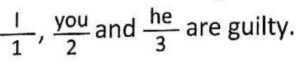
Which one is the correct sentence given below?
(a) You, he and I went there.
(b) He, you and I went there.
(c) I, you and he went there.
(d) You, I and he went there.
Basic Rule-12. নিম্নের noun গুলো uncountable তাই এরা singular subject অতএব এদের পর singular verb বসবে।
Important Uncountable Nouns
| Uncountable | Meaning | Uncountable | Meaning | Uncountable | Meaning |
|---|---|---|---|---|---|
|
Advice |
উপদেশ |
Equipment |
উপকরণ |
Machinery |
যন্ত্রপাতি |
|
Accommodation |
আবাসন |
Hair |
চুল |
Poetry |
কবিতা |
|
Furniture |
আসবাবপত্র |
Laughter |
হাসি |
Scenery |
দৃশ্য |
|
Information |
তথ্য |
Music |
সংগীত |
Soap |
সাবান |
|
Work |
কাজ |
Weather |
আবহাওয়া |
Expenditure |
ব্যয় |
মনের রাখার উপায়: FAHIM, SWAN, PEN থেকে মনে রাখা যায়।
| FAHIM | SWAN | PEN |
|---|---|---|
|
F = Furniture, Fun, Food A = Advice, Anger Accommodation; H = Hair, Hatred, Homework; I = Information, Ink; M = Money, Music, Machinery, Milk |
S = Soap, Scenery, Sugar; W = Work, Weather, Wind; A = Advice N = News |
P = Poetry, Poverty, Permission, Progress; E = Equipment, Expenditure; N = News |
একটি গল্প থেকে নিষ্পাপ সাইফুল সকালে Keya Beauty Soap সাবান দিয়ে ভালভাবে গোসল করে Furniture এ হেলান দিয়ে ‘ফাইটা যায় আর জ্বইলা যায়’ Music শুনিতেছে। তার পকেটে ছিল না কোনো Money আর হাতে ছিল না কোনো Work তাই Poetry এর বই পড়ে Leisure time কাটাইতেছে। বাবা এই অকর্মা ছেলের কাণ্ড দেখিয়া ঘরের সব Machinery, Equipment, Luggage Damage করে দিল। সাইফুল একটু Courage করিয়া Milk এর সাথে Sugar মিশাইয়া Bread খাইল। তারপর Jewellery দোকানে গিয়ে একটা gift নিয়ে ময়ূরীকে Mail এর মাধ্যমে Information, news দিল যে আজ রাতেই দুইজন পালাবে। বাহিরের Wind, Weather খুব একটা ভাল ছিল না। তখন সে নিজের Religion ও Progress ভুলে গিয়ে আকাশে Space এর Scenery এর দিকে তাকিয়ে মাথার Hair টানিতেছে আর ময়ূরীর জন্য অপেক্ষা করিতেছে।
Uncountable Noun এর ব্যবহার
সাধারণত Uncountable Noun-Singular
এদের পূর্বে সাধারণত Article বা সংখ্যাবাচক শব্দ বসে না।
এদের সাথে সাধারণত s/es যোগ করা যায় না।
i. Inc: I need some furnitures.
Cor: I need some furniture. [DU-2004-05]
ব্যাখ্যা: Furniture-Uncountable noun তাই এর সাথে s/es যোগ করা যাবে না।
ii. Inc: Her hairs are falling
Cor: Her hair is falling
ব্যাখ্যা: Hair-Uncountable noun তাই hairs হবে না এবং singular- hair হবে।
iii. Inc: The weather is fine
Cor: Weather is fine.
ব্যাখ্যা: Weather- Uncountable noun তাই শুধু weather হবে। তবে The +Noun+of+Noun এই নিয়মে সকল noun এর পূর্বে article the বসতে পারে।
যেমন: The weather of this area is fine.
iv. ____ is not the only thing that tourists want to see. [24th BCS]
(a) A scenery
(b) Sceneries
(c) The sceneries
(d) Scenery
Ans : D
v. In order to improve farming methods, we need___ [24th BCS]
(a) machine
(b) machinery
(c) a machinery
(d) machineries
Ans : B
Basic Rule-13: Determiners- যে সকল শব্দ বা শব্দগুচ্ছ কোনো Noun বা Pronoun এর পূর্বে বসে তাদের সংখ্যা, পরিমাণ, নির্দিষ্টতা বা অনির্দিষ্টতা ইত্যাদি নির্দেশ করে তাদেরকে Determiners বলে।
◇কোনো ব্যক্তি বা বস্তুকে নির্দিষ্টতা বা অনির্দিষ্টতা বোঝাতে নিচের Determiners গুলো ব্যবহৃত হয়।
Articles: A, an, the.
Possessive Adjective: My, our, his, her, their, your, its etc.
Demonstrative : This, that, these, those etc.
◇ কোনো ব্যক্তি বা বস্তুকে সংখ্যা বা পরিমাণ বুঝাতে নিচের Determiners গুলো ব্যবহৃত হয়। Much, many, a lot of, an amount of, less, few, little, another, each, either, neither etc.
i. There is a lot of dust on this book. [সাব-রেজিস্ট্রার-২০০৩]
ii. Always speak the truth.
iii. These books are my favorite.
iv. Mr. Amin has much money to buy a car.
ব্যাখ্যা: উপরের Underlined কৃত Word গুলো এক একটি Determiner। এগুলো সব সময় Noun এর পূর্বে বসে Noun কে Modify করে। এরা Noun এর পূর্বে বসে বিধায় এরা Adjective এর কাজ করে।
Some Determiners
A, an, the, any, many, much, few, fewer, little, less, all, another, each, every, either, no, neither, this, that, these, those, my, our, your, his, her, their, its, a lot of, lots of, an amount of etc.
| অনেক | একদম নেই | অল্প কিছু | প্রচুর | Noun |
|---|---|---|---|---|
|
Many |
Few |
A few |
A number of |
Countable Noun |
|
Much |
Little |
A little |
An amount of |
Uncountable Noun |
কখনই Only few / only little হয় না সব সময় Only a few / only a little হয়।
i. I have few friends in BD. [প্রধানমন্ত্রীর কার্যালয়-২০০৪]
ii. I still have little money in pocket. [সড়ক জনপথ (সিভিল ইঞ্জিনিয়ার)-২০১৩]
iii. Incorrect: I have little books.
Correct : I have few books.
iv. Incorrect: I have few money.
Correct : I have little money.
Which word is the determiner in the sentence “Will it take much time”? [35th BCS]
(a) will
(b) take
(c) much
(d) time
Ans: c
Basic Rule-14: But, Or, Nor দ্বারা দুটি Noun/Pronoun যুক্ত হলে নিকটবর্তী Noun/Pronoun এর উপর ভিত্তি করে Verb বসে। অর্থাৎ পরবর্তী subject অনুসারে Verb বসে |
মনে রাখার কৌশল: BON দ্বারা যুক্ত হলে পরের Subject অনুসারে Verb বসে।
B=But = Not …. but
O = Or = Either ….. or
N = Nor = Neither… nor, Not only but also
i. Neither Rini nor Simi is qualified for the job. [29th BCS]
ii. Either the manager or his assistants review the company’s personnel needs. [ডাচ বাংলা ব্যাংক-২০১০]
iii. Either you or I am wrong. [Hstu-14-15]
iv. Neither the players nor the trainer was in the room. [SIBL-TSO-2013]
Basic Rule-15 : জাতির পূর্বে The বসে কিন্তু ভাষার পূর্বে The বসে না। [The + জাতি + PV (plural verb), ভাষা + SV (Singular verb)]
Examples:
(i) Incor: Bangaly are good nation.
Cor: The Bangaly are a good nation. [সরকারি মাধ্যমিক শিক্ষক নিয়োগ পরীক্ষা-২০১১]
(ii) Incor: English is a polite nation
Cor: The English are a polite nation
ব্যাখ্যা: এখানে শেষে বলা হয়েছে nation = জাতি, তাই English (ভাষা) is না হয়ে The English (জাতি) are হবে।
iii) Incor: The English are an international language.
Cor: English is an international language.
ব্যাখ্যা: এখানে শেষে বলা হয়েছে language = (ভাষা), তাই The English (জাতি) are না হয়ে English (ভাষা) is হবে।
Basic Rule-16: Name, Clause, Collective noun, Time, Distance, Dollar ইত্যাদি বাক্যের Subject হলে Verb Singular হয়.
মনে রাখার কৌশল: NCTD বাক্যের Subject হলে Verb Singular হবে।
N = Name = কোনো বই, ব্যক্তি অথবা অন্য যেকোনো কিছুর নাম
C = Collective Noun, Clause
T = Time
D = Distance, Dollar
এরা বাক্যের Subject হলে Verb Singular.
- The Arabian Nights is still a great book. [26th BCS]
- Ten thousand dollars is a lot of money. [D U. (C) 14-15]
- Ten miles is too far to walk. [CU (F)-1013-14]
- Physics is my favorite subject. [পরিবেশ ও বন মন্ত্রণালয়-০৬]
Basic Rule-17: A Number of +PN(Plural Noun) + PV (Plural Verb) কিন্তু The Number of +PN (Plural Noun) + SV (Singular verb)
i. Incor: A number of boy is present on today’s class.
Corr: A number of boys are present on today’s class.
ii.Incor: A number of Banks uses computer.
Corr: A number of Banks use computers. [RU-2013-14]
iii. Incor: There is a large number of boys playing in the field.
Corr: There are a large number of boys playing in the field. [খাদ্য ও দুর্যোগ ব্যবস্থাপনা-২০০৪]
ব্যাখ্যা: এখানে A number of এর পর Noun ও Verb Plural.
iv.Incorr: The number of girl are present today’s program.
Corr: The number of girls is present today’s program.
v. Incor: The number of people were very high. [যুব উন্নয়ন অধিদপ্তর -১৯৯৯]
Corr: The number of people was very high.
ব্যাখ্যা: এখানে the number of এর পর Noun Plural কিন্তু Verb Singular.
Bajsic Rule-18: About + Infinitive অর্থাৎ about + to + verb দ্বারা কোন কাজ হবে হবে অবস্থা বোঝায় বা কোনো কাজ বাকি থাকা বোঝায়।
যেমন:
i. তার মর মর অবস্থা -He is about to die.
ii. ফুলটি ফুটি ফুটি করিয়াও ফুটিল না – The flower was about to bloom but did not bloom. –
iii. সন্ধ্যাকালে চাঁদটি উঠি উঠি করিতেছে – The moon is about to rise in the evening sky.
iv. সে প্রায় মারা যেতে চলেছে – He is about to die.
v. তাহারা যাইতে উদ্যত হইল – They are about to go.
vi. আমি প্রায় নদীতে ডুবে যাচ্ছিলাম -I was about to drown in the river.
vii. শীত যাই- যাই করিয়াও যাইল না -The cold weather was about to disappear but did not.
Basic Rule-19: Gerund এবং Present Particple এর মধ্যে পার্থক্য
Gerund
Gerund: Verb এর সাথে ing যোগ হয়ে যদি Noun এর কাজ করে অর্থাৎ Verb ও Noun এর কাজ করে, তাহলে তাকে Gerund বলে।
সংক্ষেপে
: Gerund = verb + ing = noun = verb + noun
Gerund দ্বারা স্থির অবস্থা বা কাজ বোঝায়।
Example:
(a) Swimming is good for health.
(b) I like dancing.
(c) Reading books is my hobby.
ব্যাখ্যা: উপরের বাক্যগুলোতে Swimming, Reading, dancing শব্দগুলো দ্বারা কাজ বুঝিয়েছে।
তাই উক্ত শব্দগুলোকে Gerund নামে অবিহিত করা যায়।
Reading is an excellent habit. Here, the underlined word is a _____ [38th BCS]
(a) Verbal noun
(b) Particple
(c) Verb
(d) Gerund
Ans : (d)
PRESENT PARTICIPLE
Verb এর সাথে ing যোগ হয়ে যদি Adjective এর কাজ করে অর্থাৎ Verb ও Adjective এর কাজ করে, তাহলে তাকে Present Participle নামে অভিহিত করা হয়।
সংক্ষেপে: present Participle = verb + ing = adjective = verb + Adjective
Present Participle দ্বারা চলমান sense বোঝায়।
Example:
(a) A rolling stone gathers no moss.
(b) She is swimming.
(c) I saw a flying bird.
ব্যাখ্যা: উপরের বাক্যগুলোর rolling, swimming, flying দ্বারা চলমান বোঝায়। তাই তারা present participle.
Use of the present participle:
[এখন Present participle এর ব্যবহার দেখা যাক।
Present Participle: (verb+ing)
1. A Participle can qualify a Noun. (বাংলায় ‘মান’ বা ‘অন্ত’ প্রত্যয়যুক্ত বিশেষণ)
i. A rolling stone gathers no moss. (Rolling = ঘূর্ণমান)
ii. Don’t try to get into a running train. (Running = চলন্ত)
iii. A blooming flower is beautiful to look at. (Blooming = ফুটন্ত)
iv. Don’t put your hand in boiling water. (Boiling = ফুটন্ত)
ব্যাখ্যা: উপরের Rolling, running, blooming, boiling- Underline কৃত যুক্ত শব্দগুলো যথাক্রমে stone, train, flower, water- Noun word গুলোকে Modify করছে, তাই এরা Participle এবং এরা Adjective এর কাজ করছে।
(2) It may govern a Noun or a Pronoun: (বাংলায় ‘ইয়া’- অন্ত অসমাপিকা ক্রিয়া)
i. Hearing the noise, the boy woke up.- [গোলমাল শুনিয়া (শুনে) ছেলেটি জাগিয়া (জেগে) উঠিল (উঠল)]
[The noun ‘noise’ is governed by the participle ‘hearing’.]
ii. Seeing him fall from the tree, I rushed towards him.
(তাহাকে গাছ হইতে পড়িতে দেখিয়া আমি তাহার দিকে ছুটিয়া গেলাম]
[The pronoun ‘him’ is governed by the participle ‘seeing’]
(3) It may be modified by an adverb:
Loudly knocking at the gate, he asked admission.
[The participle ‘knocking’ is modified by the adverb ‘loudly’]
[উপরের উদাহরণে Participle এর শেষে ing আছে এবং ঘটমান কোনো কাজকে বোঝাচ্ছে, তাই এগুলোকে Present Participle বলে।]
Gerund and Present Participle
| Gerund | Present Participle |
|---|---|
|
He is fond of playing cricket. |
Playing cricket, he spent much time. |
|
The old man is tired of walking. |
Walking along the road, the old man is tired. |
|
I don’t like laughing so loud. |
They went away laughing. |
|
On hearing the noise, he woke up. |
Hearing the noise, he woke up. |
Present Participle এর ব্যবহার:
| Gerund | Present Participle |
|---|---|
|
চলন্ত ট্রেন থেকে লাফ দিও না |
Do not jump from a running train. |
|
জেলের ডিঙিখানা উল্টে গেল |
The fishing boat capsized. |
|
আমি দেখলাম সে যন্ত্রণায় চিৎকার করছে |
I found him crying with pain. |
|
ফুটন্ত ফুলের মাঝে দেখবে মায়ের হাসি |
Just have a look at the sweet smile of mother in the blooming flowers. |
|
হাসিমাখা মুখ |
A smiling face. |
|
উদীয়মান সূর্য |
The rising sun. |
|
মৃত্যুকালীন ঘোষণা |
The dying declaration. |
[এখানে smiling, rising ইত্যাদি Participle যেমন পরবর্তী noun- গুলিকে Qualify করছে, তেমনি কোনো না কোনো অসমাপ্ত কাজকে বোঝাচ্ছে। এগুলি তাই একই সঙ্গে verb এবং Adjective]
কিন্তু, বাঁচিবার মতো বেতন- living wages. বেড়াইবার ছড়ি- A walking stick.
[এখানে living, walking এগুলি Participle নয়, Gerund, কারণ এরা Part of a Compound Noun]
Gerund এর ব্যবহার:
১) ইহা কিনিবার যোগ্য- It is worth buying.
২) মেয়েটি কাঁদিয়া উঠিল- The girl burst out crying.
৩) সকলেই প্রশংসা ভালোবাসে- Everybody is fond of being praised.
[এখানে ‘being’ হয়েছে Gerund কারণ, এটি ‘of’ Preposition- এর object হয়েছে ।।
Basic Rule-20: Gerund, Infinitive, Each, Every, Either, Neither ইত্যাদি বাক্যের Subject হলে Verb Singular হয়।
মনে রাখার কৌশল: GENI বাক্যের Subject হলে Verb Singular হয়।
G = Gerund
E = Each, Every, Either
N = Neither
I = Infinitive
এরা বাক্যের Subject হলে এদের পর Verb Singular হবে।
যেমন:
- Each boy and each girl was given prize.
- To know her is to like her
- Reading books is my hobby.
- To ride well recquires practice. [RU-2009-10/JNU-2011-12)
- Maintaining expenses is very difficult.
Basic Rule-21: Nouns those are always plural: যেসব জিনিস দুটো নিয়ে set হয় সেই সব noun এর পূর্বে pair শব্দ উল্লেখ থাকলে singular verb হয় কিন্তু pair শব্দটি না থাকলে plural verb ব্যবহৃত হয়।
যেমন: Scissors, Shorts, Pants, Jeans, Trousers, Tongs, Tweezers, Eyeglasses, Pliers
Examples:
Incorr: The pants is in the drawer.
Corr: The pants are in the drawer.
ব্যাখ্যা: এখানে pants থাকায় verb টি সব সময় plural হবে।
Incorr: A pair of pants are in the drawer.
Corr: A pair of pants is in the drawer.
ব্যাখ্যা: এখানে pants এর সাথে pair থাকায় verb টি সব সময় singular হবে।
Basic Rule-22: Reciprocal Pronoun: যে Pronoun দ্বারা দুই বা ততোধিক ব্যক্তির মধ্যে পরস্পরকে বুঝায় তাকে Reciprocal Pronoun বলে।
যেমন: Each other- দুইজনের মধ্যে বোঝাতে
One another– দুইজনের অধিক।
Examples:
- Ten students love one another.
- The two sisters help each other.
- Rakhi and Rakib aren’t dating each other any more.
- The students are talking one another.
- Mamun and Sanjida are dating each other.
Note: সাধারণত দু’জনের মধ্যে পারস্পরিক সম্পর্ক বোঝাতে Each other এবং দুইয়ের অধিক ব্যক্তির মধ্যে পারস্পরিক সম্পর্ক বোঝাতে One another ব্যবহৃত হয়। Each other / One another সাধারণত বাক্যের শেষে বসে।
Basic Rule-23: Dues, Earnings, Winnings, wages এই শব্দগুলোর পর Verb Plural হবে।
i. Incor: My earnings is inadequate to meet my expenses.
Corr: My earnings are inadequate to meet my expenses.
ব্যাখ্যা: earnings এর পরবর্তী verb টি সব সময় plural হবে।
ii. Incor: All dues is invisible.
Corr: All dues are invisible.
ব্যাখ্যা: dues এর পরবর্তী verb টি সব সময় plural হবে।
Basic Rule-24: VERBAL NOUN ⇒ সাধারণত Gerund এর পূর্বে the এবং পরে of থাকলে তাকে verbal Noun বলে।
সংক্ষেপে:
The + verb + ing + of Verbal Noun.
The reading of this book is interesting.
All verbal Nouns are not Gerund, but all Gerunds are Verbal Nouns.
(সমস্ত Verbal Noun – ই Gerund নয়, কিন্তু সমস্ত Gerund ই Verbal Noun.)
Basic Rule-25: Since ও For এর ব্যবহার
Since = ধরে/ ব্যাপ্তি (point of time)
For = থেকে/ ব্যাপ্তির শুরু (duration of time)
সকল Prefect continuous tense-এ since/for + time বসে। তবে মাঝে মাঝে have been/has been/had been যুক্ত Perfect tense-এ ও since/for + time বসে।
Since + নির্দিষ্ট দিন, মাস, বছর, সাল ইত্যাদি থাকে অর্থাৎ একটি নির্দিষ্ট point থেকে শুরু বোঝায়।
Examle:
i. He has been reading since morning.
ii. It has been raining since last Sunday. [SIBL-TSO-2013]
iii. He had been ill since 2002
iv. He has been living here since 1999.
v. সে গত রবিবার থেকে অসুস্থ- He has been ill since Sunday last.
Examle:
i. He has been reading since morning.
ii. It has been raining since last Sunday. [SIBL-TSO-2013]
iii. He had been ill since 2002
iv. He has been living here since 1999.
v. সে গত রবিবার থেকে অসুস্থ- He has been ill since Sunday last.
For + 1, 2, 3, 4 ইত্যাদি থাকে অর্থাৎ একটি duration থাকে অর্থাৎ শুরু ও শেষ থাকে।
i. He has been living here for 2 years.
ii. It has been raining for 3 days. [সহকারী পরিচালক (পাসপোর্ট)-২০০৩]
iii. He had been ill for 3 weeks.
iv. আমি তাকে এক সপ্তাহ দেখিনি – I have not seen him for a week.
Examples:
i. He has been ill ___ Friday last. [26th BCS]
A) From
B) on
C) In
D) Since
Ans : D
ব্যাখ্যা: Present Perfect Continuous Tense-এ নির্দিষ্ট সময়ের পূর্বে (point of time) sinceএবং অনির্দিষ্ট সময়ের পূর্বে (period of time) for বসে।
ii. Julia has been ill___ three months. [28th BCS]
A) since
B) about
C) in
D) for
Ans : D
ব্যাখ্যা: for-preposition টি’period of time’ অর্থাৎ অ-নির্দিষ্ট সময় বোঝাতে ব্যবহৃত হয়। অন্যদিকে since preposition point of time বা নির্দিষ্ট সময় বোঝাতে ব্যবহৃত হয়।
iii. I have been living in Dhaka ___ 2000. [36th BCS]
(a) since
(b) from
(c) after
(d) till
Ans: a
ব্যাখ্যা: Present perfect এর গঠন অনুযায়ী Sub + have/has been + মূল verb এর সাথে ing + obj + Since/for + সময় বসে। নির্দিষ্ট সময় বুঝালে since বসে আর অনির্দিষ্ট সময় বুঝালে For বসে।
Material Noun
Basic Rule-26: যে Noun কে গণনা করা যায় না শুধুমাত্র ওজন দ্বারা যাদের পরিমাণ নির্ধারণ করা হয় বা যার দ্বারা কোন পদার্থের সমুদয় অংশকে অখণ্ডভাবে বুঝায় কিন্তু সে পদার্থ হতে উৎপন্ন কোনো বস্তুকে বোঝায় না, তাকে Material Noun বলে। যেমন: Gold, Water, Iron, Mutton, Milk etc.
Material Noun: Water, Mild, Gas, Mutton, Wine (মদ) এই শব্দগুলোকে গণনা করা যায় না কিন্তু এগুলোকে ওজন করা যায়।
যথা: ১ লিটার দুধ, ১ ব্যারেল গ্যাস, ১ বোতল মদ ইত্যাদি। তাই এই শব্দগুলো Material Noun.
Features of Material Noun
১. এটি গণনা করা যাবে না;
২. এটি ওজন হিসেবে ব্যবহৃত হবে;
৩. এটি Plural form হবে না;
৪. এটির আগে Article বসবে না;
‘Mutton’ is a/an __. [38th BCS]
(a) Common noun
(c) Material noun
(b) Abstract noun
(d) Proper noun
Ans. (c)
Material Noun এবং Common Noun এর পার্থক্য
| Material Noun | Common Noun |
|---|---|
|
যে উপাদান দ্বারা তৈরি সে উপাদানের নাম
Material Noun.
|
যা তৈরি করা হয় তা Common Noun. |
|
Gold |
ring, necklace, bangles, etc. |
|
Iron |
sickle, scissors, hammar, rode, hoe, etc. |
|
Wood |
bench, door, chair, table, window, etc. |
|
Milk |
cheese, butter, curd, ghee, sweets, etc. |
|
Paper |
book, packet, magazine, newspaper, etc. |
|
Rice |
biscuit, cake, chira, muri, khai, etc. |
|
Jute |
rope, bag, cloth, mate, carpet, etc. |
Basic Rule-27: Relative Pronoun: যে Pronoun কোনো Noun বা Pronoun এর পরে বসে পূর্ববর্তী Noun বা Pronoun কে নিদের্শপূর্বক দুটি Clause- কে যুক্ত করে তাকে Relative Pronoun বলে।
যেমন: Who, Which, What, That, Whom, Whose etc.
I. This is the pen which I want. [MBSTU-2015-16]
Relative Pronoun (Who, Which, That) সবসময় তার Antecedent এর পরেই বসে এবং এর পরের Verb টি ঐ Antecedent অনুসারে বসে।
II. It is I who am your brother. (এখানে Pronoun। অনুসারে Verb am বসেছে)
III. It is you who are to blame. [JU-2014-15]
IV. It is they who were there (এখানে they অনুসারে Verb were বসেছে)
V. It is Zerin who is brilliant student. (এখানে Zerin অনুসারে Verb Is বসেছে)
Basic Rule-28: প্রশ্নে who-এর ব্যবহার আসলে, ব্যক্তি+ who + verb এভাবে বসবে। তার মানে, ব্যক্তির পরেই who বসে।
1. It was we who had left before he arrived. [DU(C)-2007-08]
2. Nazrul who is our national poet, was also a soldier. [DU(D)-2015-16]
3. Choose the correct option
(a) The man was tall who stole my bag.
(b) The man stole my bag whom was tall.
(c) The man stole my bag who was tall.
(d) The man who stole my bag was tall.
Ans : (d)
4. Choose the correct sentence: [26th BCS]
(a) The man that said that was a fool.
(b) The man who said that was a fool.
(c) The man, that said that, was a fool.
(d) The man which said that was a fool.
Ans: (b)
5. Choose the correct sentence:
(a) The man could solve the problem who first knew it.
(b) The man first knew it who could solve the problem.
(c) The man which first knew it could solve the problem
(d) The man who first knew it could solve the problem
(e) The man is honest who collects the information
Ans: (d)
6. Choose the correct sentence:
(a) The man which collects the information is honest.
(b) The man collects the information who is honest.
(c) The man who collects the information is honest.
(d) The man is honest who collects the information
Ans: (c)
7. Choose the correct sentence:
(a) The player that has played well will be awarded.
(b) The player who has played well will be awarded.
(c) The player will be awarded who has played well.
(d) The player which will has played well be awarded.
Ans : (b)
Basic Rule-29: LINKING VERB: যে Verb এর Subject ও Complement একই বিষয়কে বুঝায় সে Verb কে Linking Verb বা Copulative verb বলে।
I am a student
I = student
am = linking verb
Zerin looks beautiful.
Zerin = beautiful
looks = linking verb
এখানে প্রয়োজনীয় এবং গুরুত্বপূর্ণ কতগুলো Linking Verb দেয়া হলো:
মনে রাখার কৌশল: AB FL GR ST
A = Appear,
B = Be, Become,
F = Feel,
L = Look,
G=Go, Grow, Get,
R = Remain
S = Stay, Seem, Sound, smell
T = Taste
Linking Verb এর ব্যবহার:
i. সাধারণত verb কে modify করতে verb এরপর adverb বসে কিন্তু Linking verb এরপর Adjective বসে।
ii. কিন্তু Linking verb এরপর Noun/Pronoun বা Preposition আসলে তাদের পর Adverb বসে।
সংক্ষেপে:
1. সাধারণ Verb + Adverb
2. Linking Verb + Adjective
3. Linking Verb + N/P/Preposition + Adverb
Example:
1. He works careful/carefully.
ব্যাখ্যা: উত্তর হবে carefully, কারণ সাধারণত Verb এর পর Adverb বসে।
2. He looks careful/carefully.
ব্যাখ্যা: উত্তর হবে careful, কারণ এখানে looks- Lingking verb. সাধারণত Lingking verb এর পর Adjective বসে।
3. He looks after careful/carefully.
ব্যাখ্যা: উত্তর হবে carefully, কারণ এখানে looks- Lingking verb এর পর preposition after আছে। He looks very smart.
- He behaves friendly/in a friendly way. [DU-2003-04]
ব্যাখ্যা: উত্তর হবে in a friendly way, কারণ behaves- সাধারণ verb. সাধারণ verb এরপর adverb বসবে আর friend এর adverb হল in a friendly way. Adjective হচ্ছে friendly.
Basic Rule-30: Someone, Somebody, Something, No one, Nobody, Nothing, Everyone, Everybody, Everything, Anybody, Anyone, Anything এরা বাক্যের subject হলে এদের পর verb singular হবে।
মনে রাখার কৌশল: SANE
S = Somebody, Someone, Something
A = Anybody, Anyone, Anything
N = Nobody, No one, Nothing
E = Everybody, Every one, Everything
- Everybody has gone there. [26th BCS]
- Everything has been done to help him . [খাদ্য ও দুর্যোগ ব্যবস্থাপনা।
- Somebody has gone. [সড়ক জনপথ-২০০৩]
- Nobody has come here. [পররাষ্ট্র মন্ত্রণালয়-২০০৪]
Basic Rule-31: Hundred, thousand, million, billion, trillion, percent এ শব্দগুলি নির্দিষ্ট করে বোঝালে এদের সাথে s/es যুক্ত হয় না। কিন্তু অনির্দিষ্ট, অর্থাৎ- শত শত, হাজার হাজার, মিলিয়ন মিলিয়ন-এ রকম বোঝাতে এ শব্দগুলোর সাথে s/es যোগ করতে হয়।
যেমন: Thousands of people died in the flood last year. (Not thousand)
i. Incorrect: I have thousand of book.
Correct : I have thousands of books.
ii. Incorrect: I have 10 thousands book.
Correct : I have 10 thousand books.
iii. Incorrect: Thousand of people died in the flood last year.
Correct: Thousands of people died in the flood last year.
Basic Rule-32: দুটি ভিন্নধর্মী জিনিসের মধ্যে তুলনা করা হলে than that of বা than those of ব্যবহার করতে হয়। than that of singular এ আর than those of plural এ বসে।
অর্থাৎ একই entity এর মধ্যে Compare করতে হবে। কখনোই আলাদা দুটি জিনিসের মধ্যে Compare করা যাবে না। যদি কখনো আলাদা দুটি জিনিসের মধ্যে Compare করা হয় তাহলে Illogical Comparison হয়। এ কারণে যদি কখনো এ রকম ভাবে Compare করা হয় তাহলে that of কিংবা those of use করতে হয়।
i. Incorrect: The climate of Dhaka is better than Comilla
Correct: The climate of Dhaka is better than that of Comilla.
ii. Incorrect: The girls of Comilla are better than Comilla.
Correct: The girls of Comilla are better than those of Comilla.
iii. The income of college teacher is much less than that of a Doctor. [EMBA-DU
iv.The facilities of older hospital are as good as or better than those of new hospital. [CU (E)]
Basic Rule-33: একটি বাক্যে যখন একই সাথে Adverb of Manner, Adverb of Place & Adverb of Time দেওয়া থাকবে তখন MPT (Manner, Place, Time) এই Order বা ক্রম অনুসারে বসবে।
Adverb এর Serial: First: M-Manner (sincerely ) + Second: P-Place (office )+ Third: T -Time (everyday)
Example:
i. Mamun works sincerely in his office everyday.
ii. Alamin plays cricket nicely in the field every afternoon.
iii. Zerin went there at 9.00 pm.
Basic Rule-34: যে সব শব্দের পর from বসে। মনে রাখার কৌশল READ from PC
READ PC:
R = Remote from – দূরবর্তী।
Refrain from – বিরত থাকা।
E = Exempt from অব্যাহতি দেওয়া।
Escape from পরিত্রাণ পাওয়া।
A = Absent from – অনুপস্থিত।
Abstain from – বিরত থাকা।
D = Different from – বিভিন্ন
Desist from – বিরত থাকা।
Deter from – নিরুৎসাহ করা।
Deviate from – বিচ্যুৎ হওয়া।
Debar from – বঞ্চিত করা।
Divert from – অন্যদিকে চালিত করা।
P = Prevent from প্রতিরোধ করা।
C = Cease from – বিরত থাকা।
- You should refrain yourself from smoking. [DU-2009-10]
- The village is remote from the town.
- All late comersare exempted from the fine.
- Nobody can escape from death.
- Zerin was absent from college.
- You can’t prevent me from going. [BD. Agr. Bank-2011]
- The man was absent from the meeting. [প্রধানমন্ত্রীর কার্যালযের গবেষণা কর্মকর্তা-২০১৩]
8. Choose the correct sentence: [38th BCS]
(a) He refrained to take any drastic action.
(b) He refrained on taking any drastic action.
(c) He refrained in taking any drastic action.
(d) He refrained from taking any drastic action.
Ans. (d)
Basic Rules: 35: Noun এর শেষে সাধারণত: tion, sion, hood, ship, ness, ment, ce, cy, ch, th, or, er, ur, ure, ism, ist, age, dom, y, ty, ity, ee, e, al, ry, tude, wood, ence, ance, mony, red, ock, let etc.
| Suffix | Words (Noun) | Suffix | Words (Noun) |
|---|---|---|---|
|
sion |
expression (অভিব্যক্তি) |
age |
passage, wastage [RU-2009-10] |
|
tion |
assassination (গুপ্তহত্যা), hallucination (দৃষ্টিভ্রম) |
dom |
wisdom |
|
hood |
falsehood (মিথ্যা) |
y |
honesty, beauty |
|
ship |
hardship |
ty |
Anxiety, (উদ্বেগ) Frailty (ভঙ্গুরতা) [37th BCS] |
|
ness |
sadness (বিপদ, দুঃখ) |
ity |
Gravity (মাধ্যাকর্ষণ), charity |
|
ment |
achievement (37th BCS). |
ry |
bravery |
|
ce |
coherence (সঙ্গতি), abyance [RU-2007-08] |
e |
awe (সম্ভ্রম/সম্মানবোধ)। |
|
ee |
Payee |
ch |
breach (নীতিভঙ্গ হওয়া) |
|
r |
circular |
th |
growth, truth |
|
tude |
magnitude (বিশালত্ব, বিস্তার) |
or |
selector, doer |
|
ence |
competence (কর্মদক্ষতা) |
er |
adviser (উপদেষ্টা) |
|
wood |
hollywood |
ur |
Imprimatur (অনুমোদন) |
|
mony |
parsimony (কৃপণ) |
ure |
Departure (প্রস্থান) |
|
cy |
intimacy (অন্তরঙ্গতা) |
red |
hatred (ঘৃণ্য) |
|
ism |
Optimism (আশাবাদ/শুভবাদ) |
ock |
Hillock |
|
ist |
Misogynist (নারী বিদ্বেষী), Misandrist (পুরুষ বিদ্বেষী) |
ice let |
Practice, advice Booklet (পুস্তিকা) |
Questions from exam
নিচের উদাহরণগুলো থেকে বিভিন্ন প্রতিযোগিতামূলক পরীক্ষায় প্রায় প্রশ্ন কমন পড়ে থাকে। তাই এগুলো মনে রাখা অত্যন্ত গুরুত্বপূর্ণ।
- Frailty the name is women. Here ‘Frailty’ is a noun. [37th BCS]
- Accommodation is a noun [প্রাথমিক বিদ্যালয় সহকারী শিক্ষক পরীক্ষা-১৯৯২]
- What is the parts of speech of the word ‘measurement’ noun [জেলা দুর্নীতি সমন অফিসার-১৯৯৪]
- Break এর noun হলো Breach/Breakage [কর্মসংস্থান ব্যাংক ডাটা এন্ট্রি অফিসার-১১]
- Advise এর noun হলো Advice [রাজশাহী বিশ্ববিদ্যালয়- ২০০৯-১০]
- Transcend এর noun হলো Transcendence (সীমাতিক্রমী) [রাজশাহী বিশ্ববিদ্যালয়- ২০০৯-১০]
- Deny এর noun হলো Denial (প্রত্যাখ্যান) [প্রাথমিক বিদ্যালয় সহকারী শিক্ষক পরীক্ষা-১২]
- Poor এর noun হলো Poverty [প্রাথমিক বিদ্যালয় সহকারী-১২] RU 2012-13
- Compel এর noun হলো Compulsion [D.U- 2010-11]
- Repeat এর noun হলো Repetition
- Know এর noun হলো Knowledge (RU-2012-13)
- Hate এর noun হলো Hatred [প্রাথমিক বিদ্যালয় সহকারী শিক্ষক পরীক্ষা-১১]
- See এর noun হলো Sight
- Fly এর noun হলো Flight
- Waste এর noun হলো Wastage (RU 2009-10)
- Stupid এর noun হলো Stupidity [NBR-12]
- Grand এর noun হলো Grandeur (মহিমা) (CU 2009-10)
- Vary এর noun হলো Variation/Variety (27th BCS)
- Beautiful এর noun হলো Beauty
- Brief এর noun হলো Brevity (RU 2009-10, JNU 2011-12)
- Master এর noun হলো Mastery/Master [35th BCS]
- Do এর noun হলো Deed/Doer [C.U-2012-13]
- Defer এর noun হলো Deferment (স্থগিতকরণ) [C-Unit-D.U-2013-14]
- Assure এর noun হলো Assurance (আত্মবিশ্বাস) [তথ্য মন্ত্রণালয়ের অধীনে সহকারী তথ্য অফিসার-১৩]
Basic Rules - 36 : Adjective এর শেষে সাধারণত- tive, sive, ful, nt, ic, ry, ary, ory, ing, ed, less, ish, some, like, al, able, ible, ous, ইত্যাদি থাকে।
| Suffix | Words (Adjective) |
|---|---|
|
tive |
abortive (ব্যর্থ/নিস্ফল) |
|
sive |
abrasive (ঘষে ক্ষয়সাধনে সক্ষম), (Decisive-চূড়ান্ত, নিশ্চায়ক) |
|
ful |
awful (ভয়ানক), wonderful
[শিক্ষা অধিদপ্তর-২০১৩]
|
|
nt |
abeyant (স্থগিত) |
|
ic |
artistic (রুচিসম্মত), (Diplomatic-কূটনৈতিক)
(স্বরাষ্ট্র মন্ত্রণালয়ে কারা তত্ত্বাবধায়ক-১৩)
|
|
ary |
hereditary (পরস্পরাগত/বংশগত)
[35th BCS], Necessary
|
|
ory |
statutory (সংবিধিবদ্ধ), extraordinary
(medical, 16-17)
|
|
ing |
absorbing (চিত্তাকর্ষক), heartening |
|
ed |
adorned (সুসজ্জিত), abandoned
[JU (A)-2014-15]
|
|
less |
dauntless (ভীতিহীন) |
|
ish |
bookish |
|
some |
quarrelsome |
|
like |
childlike |
|
al |
economical (মিতব্যয়ী) |
|
able |
sustainable (টেকসই) |
|
ible |
audible (শ্রবণসাধ্য), (Divisible – নিঃশেষে বিভাজ্য)
(D.U-2013-14)
|
|
ous |
deleterious (ক্ষতিকর), perilous (ক্ষতিকর), meritorious
[পরিবার পরিকল্পনা অধিদপ্তর-২০১১]
|
Basic Rule-37: Appropriate Preposition of
মনে রাখার কৌশল : BD JORINA LOVES TOMPA
BD:
B = Bereft of = বঞ্চিত
Boast of = গর্ব করা
Blind of = অন্ধ
D = Despair of = হতাশ হওয়া
Devoid of = বর্জিত
JORINA:
J = Jealous of = ঈর্ষাপরায়ণ
O = Oblivious of = অচেতন/ মনভোলা
R = Repent of = অনুশোচনা হওয়া/ অনুতপ্ত হওয়া
Rob of = সম্পদ হরণকারি/ ডাকাতি
I = Ignorant of = অজ্ঞ/অনবহিত
Incapable of = অসমর্থ/অক্ষম
N = In need of = প্রয়োজনে
A = Accused of = অভিযুক্ত
Admit of = স্বীকৃতি পাওয়া
Ashamed of = লজ্জিত
Acquit of = মুক্তি দেওয়া, বেকসুর খালাস দেওয়া।
LOVES:
L = Lack of = ঘাটতি/অভাব
O = Observant of = মনোযোগী
V = Vain of = অহঙ্কারি
E = Envious of = ঈর্ষান্বিত
S = Sanguine of = নিশ্চিত/আশাবাদী
TOMPA:
T = Tolerant of = সহনশীল/সহিষ্ণ
O = Omnibus = অচেতন/ মনভোলা
M = Mindful of = মনোযোগী/সচেতন
Made of = তৈরি করা
P = Proud of = গর্ব করা
A = Avail of = সদ্ব্যবহার করা/ কাজে লাগানো
Some examples are given below
- Your conduct admit of no excuse. [29th BCS]
- Zerin was bereft of motherly affection.
- A lazy boy always despairs of success in life. [প্রধান শিক্ষক নিয়োগ পরীক্ষা-২০০৯]
- He is devoid of common sense. [26th BCS]
- I am not at all jealous of his fortune.
- Javed was acquitted of the charges of theft [DU. B-17-18]
- Somebody robbed him of his purse.
- He is ignorant of the rule. [RU-2013-14]
- Do not boast of beauty. [JNU-2007-08]
- He was accused of theft. [NBR-2012]
Basic Rule-38: Rise এর মানে হলো বিছানা ছাড়া, ঘুম থেকে ওঠা, দাম বাড়া, ওপরে ওঠা, সূর্য বা চন্দ্র ওঠা। Rise হলো অকর্মক ক্রিয়া; তাই এর পরে কোনো object বা কর্ম বসানোর দরকার নাই। Raise মানে উত্তোলন করা। এটি সকর্মক ক্রিয়া; তাই এর পরে object বা কর্ম বসবে।
Arise প্রায়ই rise এর স্থলে ব্যবহার করা হয়। উদ্ভূত হওয়া বা শুরু হওয়া অর্থেই Arise ব্যবহার করতে হবে।
i. Subject + raise (উত্তোলন করা) + object
ii. Subject + rise (ঘুম থেকে ওঠা) + no object.
i. Inc: Mother raises very early in the morning.
Cor: Mother rises very early in the morning.
ii. Inc: The box is too heavy; I cannot rise it.
Cor: The box is too heavy; I cannot raise it.
iii. The prices of rice are _____ . [28th BCS]
(a) raising
(b) riser
(c) rising
(d) raised
Ans: (c)
Basic Rule-39: যে সকল Preposition এর সাথে in বসে
গল্প-১:
Persist = নাছোড়বান্দার মত অটল থাকা, Excel = অন্যদের চাইতে ভালো করা, ছাড়িয়ে যাওয়া, Indulge – প্রশ্রয় দেওয়া। টুনটুনি টিকটিকির ভালবাসাতে মগ্ন হয়ে (indulge in) জীবনে বড় একটা Mistake করল। তাদের ভালবাসাকে Succeed করার জন্যে Assist করেছিল তেলাপোকা। কিন্তু তেলাপোকা নিজেই টুনটুনির ভালবাসা পাওয়ার জন্যে একেবারে Persist করে। তেলাপোকা টুনটুনির প্রতি অন্যের ভালবাসাকে Excel করে তার রুমে in করলো, অবশেষে টুনটুনি তেলাপোকাকে বিশ্বাস (Believe, faith) করে correct সময়ে তেলাপোকার ভালবাসা গ্রহণ করে Right কাজ করল।
অর্থাৎ, indulge, Mistake, succeed, assist, persist, believe, faith, correct, right এদের পরে in’ বসে।
Indulge in = আসক্ত হওয়া : Do not indulge in wire.
Excel in= গুণে/ কৃতিত্বে শ্রেষ্ঠ হওয়া: He excels in painting.
Persist in= লেগে থাকা = He persisted in disturbing me.
এরূপভাবে
i. I succeed in solving the problem.
ii. We should not indulge in smoking.
iii. The boy excels in speaking English
iv. He was right/mistaken in thinking so
v. We believe in god.
vi. Fill up the appropriate word—–“He persists——disturbing me”
(a) on
(b) at
(c) in
(d) with
Ans: (c)
মেডিকেল কলেজ ভর্তি পরীক্ষার প্রশ্নসমুহ শিক্ষাবর্ষঃ ২০১৫-২০১৬
vii. Identify the correct sentences. [23rd BCS]
(a) She had faith in and hopes for the future.
(b) She had faith and hopes for the future.
(c) She had faith and hopes in the future.
(d) She had faith and hopes in future.
Ans : (a)
Basic Rule-40: Used to ও get/be used to এর ব্যবহার।
Sub+ Used to + V এর base form
Sub + get/be (am, is, are, was, were) + Verb + ing.
Incor: Sanjida used to making tea.
Cor: Sanjida used to make tea.
Incor: Mamun is used to watch TV.
Cor: Mamun is used to watching TV.
Choose the correct sentence:
(a) He is used to work hard.
(b) He is used to working hard.
(c) He used to working hard.
(d) He has uesd to working hard.
Ans : (b)
[DU. B Unit 17-18] , পিএসসি ও অন্যান্য নিয়োগ পরীক্ষা বিভিন্ন মন্ত্রণালয় | ব্যক্তিগত কর্মকর্তা | 28-02-2022
Basic Rule-41: Sentence-এ [Always, often, how often, very often, never, occasionally, usually, generally, frequently, regularly, ever y+ time (every + day / week / morning), sometimes, on Monday, ever, twice, in Summer etc.] থাকলে Present Indefinite Tense হয়।
Structure: Subject + PV1 + (s, es) + Object
মনে রাখার কৌশল: OUR GARDENS
O = Often
U = Usually
R = Regularly
G = Generally
A = Always
R = Regularly
D = Daily
E = Everyday
N = Normally
S = Sometimes
এই শব্দগুলো বাক্যে থাকলে সাধারণত present Indefinite tense হয়।
যেমন:
- Mamun does not have to dress formally to work but he always does
- Amin usually makes the mistakes.
Zerin sometimes comes in Dhaka University campus to meet me.
I always remember the holidays I spent in your home. [25th BCS]
We often read newspaper. [DU (A) 2007-08]
Basic Rule-42: Later ও latter এর ব্যবহার
Later = পর = Time
Latter = পরবর্তী = Position/place
Incorrect: Zerin came to school latter than I.
Correct: Zerin came to school later than I.
Incorrect: Open the later chapter.
Correct: Open the latter chapter.
Basic Rule-43: Inversion/Negative Emphasis
Inversion অর্থ উল্টো বা বিপরীত। সাধারণত auxiliary verb-Subject এর পূর্বে চলে আসলে interrogative sentence হয় কিন্তু Inversion এর নিয়মে Auxilary verb subject এর পূর্বে বসলেও interrogative হয় না।
Negative adverb বাক্যে শুরুতে বসলে Auxiliary verb টি subject এর পূর্বে বসবে।
| Negative adverb | অর্থ | Negative adverb | অর্থ | Negative adverb | অর্থ |
|---|---|---|---|---|---|
|
Hardly |
কদাচিৎ |
Scarcely |
খুব কমই |
Never |
কখনই না |
|
Rarely |
কদাচিৎ |
Barely |
মাত্র |
Never before |
এর আগে কখনো হয়নি |
|
No sooner |
যেইমাত্র…অমনি |
Seldom |
কদাচিৎ |
Never again |
আর কখনো নয় |
|
Not one |
একটাও না |
Not once |
একবার নয় |
Not |
না |
|
Until |
পর্যন্ত |
Not only |
শুধু যে…তা নয় |
Only after |
শুধু পরে |
মনে রাখার কৌশল: NASMA
N = Negative word
A = Auxiliary verb
S = Subject
M = Main verb
A = Additional/Adverb
No sooner had we reached the station than the train left.
N A S M A
Example:
Incorrect: Hardly I have visited the place.
Correct: Hardly have I visited the place.
Incorrect: Only with hard working you will get chance in Dhaka University.
Correct: Only with hard working will you get chance in Dhaka University.
I hardly ever go to concerts.
I can hardly wait for my birthday.
No sooner had I arrived at the station than the train came. (= I came first and the train arrived right after me.)
No sooner had we heard the noise than we rushed to the spot.
No sooner had she finished one project than she started working on the next.
No sooner had I closed my eyes than I fell asleep.
Hardly had I reached the station when the train came.
Scarcely had I reached the station when the train arrived.
….. so many people been out of work as today.
(a) More than ever before
(b) Never before have
(c) In the past,there never have
(d) Formerly, there never were
Ans: (b) Never before have
ঢাকা বিশ্ববিদ্যালয় ঘ ইউনিট (2010-2011)
Basic Rule-44: Before/after: sentence-এ before-এর পূর্বে এবং after-এর পরে Past perfect tense হয় এবং বাকি অংশটি Past Indefinite tense হয়।
সংক্ষেপে: Before এর পূর্বে, After এর পরে Past perfect tense হয়
Structure:
Past perfect + Before +Past indefinite
Past indefinite + After + past perfect.
Example:
i. I had looked a good doctor before I met you. [26th BCS]
ii. Zerin had written the book before she retired. [26th BCS]
iii. She told me his name after he had left. [25th BCS]
iv. Mamun met Zerin after she had passed the exam.
Basic Rule-45: Finite Verb (সমাপিকা ক্রিয়া) যেই verb মনের ভাব সম্পূর্ণরূপে প্রকাশ করতে পারে number, person tense অনুসারে পরিবর্তিত হয় তাকে Finite Verb বলে।
Finite Verb: i. Verb এর Base form; ii. Present form; iii. Past form
- Verb-এর Base form: Be, Have, Do, Go etc
- Verb-এর present form: am, is, are, have, has, do, does, go, goes etc.
- Verb-এর past form: was, were, did, went etc
Non-finite verb (অসমাপিকা ক্রিয়া): যেই Verb মনের ভাব সম্পূর্ণরূপে প্রকাশ করতে পারে না এবং Number, person ও tense অনুসারে পরিবর্তিত হয়না, সেই verb কে বলা হয় non finite verb.
Non finite verb:
1.To + Verb বা Infinitive : To + Verb = To do, To go etc
2.V+ing বা Gerund বা Present Participle : V + ing = Doing, Going
3.Verb এর Past Participle: V3 বা Past Participle = Done, Gone
Finite Non-finite এর সম্পর্ক: প্রতিটি বাক্যে বা Clause এ অবশ্যই একটি Finite Verb থাকবে। ঐ বাক্যে
বা Clause এ একের অধিক Verb আসলে বাকি Verb গুলোকে Non-finite verb এ পরিণত করতে হবে।
He has been reading this book to learn English since morning.
ব্যাখ্যা: এই বাক্যে ৪টি verb আছে has, been, reading, to learn, এদের মধ্যে has Finite Verb কারণ Verb এর present form been-V3 এবং non-finite; Reading-non finite; to earn non-finite.
| Finite verb (সমাপিকা ক্রিয়া) | Non-finite verb (অসমাপিকা ক্রিয়া)/ Infinitive |
|---|---|
|
Bimal goes to school.
|
Bimal does not like to go to school. |
|
The mangoes tastes sweet. |
The mangoes are sweet to taste. |
|
He attended three meetings. |
He had three meetings to attend. |
|
The boot is so heavy that he can not walk. |
The boot is too heavy for him to walk. |
|
We can save Bangladesh by patriotism |
Patriotism is the way to save Bangladesh. |
Basic Rule-46: Bare Infinitive [Infinitive without 'to'
Infinitive- এর সঙ্গে প্রায়শই to ব্যবহৃত হয়। কিন্তু bid, let, make, need, dare, see, hear verb-এর পর Infinitive করতে হলে to ব্যবহৃত হয় না।
আমি তাকে যেতে আদেশ করলাম – I bade him go.
তাকে সেখানে বসতে দাও – Let him sit there.
আমি তোমাকে যেতে দেব না – I will not let you go.
আমি তাকে ছুটতে বাধ্য করলাম -I made him run.
তোমার আজ যাওয়ার প্রয়োজন নেই – You need not go today.
আমরা তাকে কাজটি করতে দেখলাম -We saw him do the work.
আমি তাকে কাঁদতে শুনলাম – I heard him/her cry.
তোমার এটি করতে সাহস করা উচিত নয় – You dare not do it.
Basic Rule-47: In time ও On time এর ব্যবহার।
On time: fixed time/সুনির্দিষ্ট সম বোঝাতে On time বসে (on time means at the planned time, neither late nor early)
In time: নির্দিষ্ট সময়ের পূর্বে বা পরে বোঝাতে In time বসে। (In time means with enough time to spare, before the last moment)
(a) The train came on time but we arrived in time to get good seats.
(b) When he reached the air-port in time, the plane took off on time.
(c) The train is running on time.
(d) Drivers stopped the car on time to avoid the collision. [DU (EMBA)]
Choose the correct Sentence. [26th BCS]
(a) The train is running in time.
(b) The train is running on time.
(c) The train is running with time.
(d) The train is running to time.
Ans : (b)
ব্যাখ্যা: নির্দিষ্ট সময়ের পূর্বে বুঝাতে in time বসে। আর নির্দিষ্ট সময়ের পূর্বেও না পরেও না এমন সময়কে বুঝাতে on time বসে।
Basic Rule-48: Deal in deal with এর ব্যবহার।
Deal in = ব্যবসা করা He deals in rice
Deal with = আচরণ করা / ব্যবহার করা = He deals well with the customers.
He deals in foreing good.
Our firm deals with several leading merchants. [National Bank -2015]
Basic Rule-49: Conditional Sentence
If যুক্ত Clause টি যদি simple present tense হয়, তবে পরবর্তী Clause-এ future tense হয়।
| If Clause (Simple Present) | Main Clause (Will/shall/can/may + verb) |
|---|---|
|
If it rains
|
I’ll stay at home. |
|
If he runs all the time |
he can get there in time. |
. If যুক্ত Clause-এ যদি verb-টি past form (be verb = were)-এ হয়, তবে পরবর্তী clause-এ would/could / might এর পর verb এর base form হয়।
| If Clause (Simple Past) | Main Clause (would/could+ verb) |
|---|---|
|
If I had a degree
|
I could get a job easily. |
|
If I dropped the plate |
It would break. |
Choose the correct sentence.
(a) If I found bag in the street, I’ll be taking it to the police.
(b) If I found a bag in the street, I will take it myself.
(c) If I found a bag in the street, I’d take it to the police.
(d) If I found a bag in the street, I took to the police.
Ans: (c) If I found a bag in the street, I’d take it to the police.
মাওলানা ভাসানী বিজ্ঞান ও প্রযুক্তি বিশ্ববিদ্যালয় D ইউনিট
If clause-এ যদি (had + V3) হয়, তবে পরবর্তী clause-এ would/could/might + have + verb এর past participle form হবে।
| If Clause (Past Perfect) | Main Clause (would/could+verb Gi past participle) |
|---|---|
|
If I had seen him,
|
I could have saved him. |
|
If you had come to me |
I might have helped you. |
Note: Had + Sub + V3 + Ext এভাবে কোন Sentence শুরু হলে সেটিও Perfect conditional/ 3rd Conditional হয়।
যেমন:
- Had I been a king, I would have helped the poor.
- Had he known anything, he would have told me.
Zero Conditional
জিরো কন্ডিশনাল বাক্যগুলো সাধারণত চিরন্তন সত্য বা বৈজ্ঞানিক সত্য প্রকাশ করতে ব্যবহৃত হয়। এ ধরনের বাক্যে দুটিই Present Simple Tense ব্যবহার করা হয়: ‘if’ যুক্ত অংশ (if clause) এবং মূল অংশ (main clause)।
গঠন: If + Present Simple + Present Simple
উদাহরণ:
যদি তুমি বরফ গরম করো, তবে তা গলে যায়- If you heat ice, it melts.
যদি সূর্য অস্ত যায়, তবে রাত হয়- If the sun goes down, it gets dark.
যদি তুমি আমাকে একটি প্রশ্ন জিজ্ঞাসা করো, তবে আমি উত্তর দিই- If you ask me a question, I answer it.
If clause-এ যদি Present Simple থাকে তাহলে পরবর্তী clause ও Present Simple হবে।
যেমন:
. If water is heated, it boils at 100 degree C temperature.
If we heat ice, it melts.
Choose the correct sentence :
(a) If I find a bag in the street, I take it to the police.
(b) If I find a bag in the street, I took it to the police
(c) If I find a bag in the street, I will take it to the police.
(d) If I find a bag in the street, I had to take it to the police.
Ans: (c) If I find a bag in the street, I will take it to the police.
Janata Bank Ltd Janata Bank Ltd – Asst. Executive Officer – 04.08.2017
If a ruby is heated it ___ temporarily lose its color.
(a) would
(b) will
(c) does
(d) has
Ans: (b) will
বিসিএস প্রিলিমিনারি + রিটেন টেস্ট ১৮ তম বিসিএস প্রিলিমিনারি টেস্ট (02-05-1997)
‘I can not but go’ বাক্যটির সঠিক বাংলা অনুবাদ হচ্ছে-
(a) আমি যাবই
(b) আমাকে যেতে হবে
(c) আমি না যেয়ে পারি না
(d) আমি যেতে পারি
Ans: (c) আমি না যেয়ে পারি না
মেডিকেল কলেজ ভর্তি পরীক্ষার প্রশ্নসমুহ শিক্ষাবর্ষঃ ২০১৬-২০১৭
If I had a car, I – place.
(a) visit
(b) visited
(c) would visit
(d) would have visited
Ans: (c)
Fill in the gap with the right tense: When water it turns into ice. [38th BCS]
(a) will freeze
(c) would freeze
(b) freezes
(d) froze
Ans: (b)
Note: If / I wish এরপর Be verb আসলে were হয়।
Example: i. I wish I were a queen. [DU(C) 2016-17]
Basic Rule-50: Cannot but/ can not help এর ব্যবহার।
Cannot but + Verb base form (অর্থাৎ Cannot but এর পর Verb এর Base form বসে ।)
Cannot help + Verb + ing (অর্থাৎ Cannot help এর পর Verb এর present form এর সাথে ing বসে।)
Example:
I can’t help going there. [বেসরকারি কলেজ প্রভাষক-২০১৩]
Limon cannot but marry the girl.
ব্যাখ্যা: এখানে can’t but এর পর marry v, বসেছে।
Limon cannot help marrying the girl.
ব্যাখ্যা: এখানে can’t help এর পর marry এর সাথে ing বসেছে।
I could not ___ laughing. [DU. A Unit 17-18]
(a) but
(b) assist
(c) help
(d) though
Ans: (c)
Basic Rule-51: 'Made of ' 'made from' এর ব্যবহার।
“Made of” এবং “Made from” এর ব্যবহার নির্ভর করে উপাদানটি থেকে তৈরি বস্তুটি চেনা যায় কিনা তার উপর। যখন উপাদানটি সহজেই দৃশ্যমান থাকে, তখন “made of” ব্যবহৃত হয়। অন্যদিকে, যখন উপাদানটি থেকে বস্তুটি তৈরির পর আসল উপাদানটি আর বোঝা যায় না, তখন “made from” ব্যবহার করা হয়।
Made of: যখন বস্তুর প্রাথমিক উপাদানটি সহজেই সনাক্ত করা যায়।
উদাহরণ: This table is made of wood (এই টেবিলটি কাঠের তৈরি)।
Made from: যখন একটি বস্তু তৈরির পর তার মূল উপাদান আর সহজে চেনা যায় না।
উদাহরণ: Paper is made from wood pulp (কাগজ কাঠের মণ্ড থেকে তৈরি হয়)।
কোনো কিছু তৈরির পর ঐ উপাদানটি দেখা গেলে made of বসে।
This table is made of wood.
This ring is made of gold.
কোনো কিছু তৈরির পর ঐ উপাদানটি দেখা না গেলে made from বসে।
The paper is made from wood/ bamboo.
[36th BCS]
নিচের কোন বাক্যটি শুদ্ধ?
(a) Paper is made of wood.
(b) Paper is made by wood.
(c) Paper is made from wood.
(d) Paper is made with wood.
Ans: (c) Paper is made from wood.
প্রাথমিক প্রধান শিক্ষক নিয়োগ পরীক্ষা প্রাথমিক বিদ্যালয় প্রধান শিক্ষক নিয়োগ পরীক্ষা-2012-(নাগলিঙ্গম-01) (9-10-2012)
MADE OF
We use ‘made of’ when the material used does not change.
- The wall is made of stones. (They are still stones)
- The ring is made of gold.
- The window is made of glass.
- The cabin was made of logs.
- The house is made of bricks.
MADE FROM
We use ‘made from’ when the material is transformed into something else.
- Wine is made from grapes. (They are no longer grapes.)
- Paper is made from wood.
- Cheese and butter are made from milk.
- Flour is made from wheat.
Basic Rule-52: সত্য কথা বলা বোঝাতে speak ব্যবহৃত হয়। আর মিথ্যা কথা বলার ক্ষেত্রে tell ব্যবহৃত হয়।
Inc : He tells the truth.
Cor: He speaks the truth.
Inc : He said a lie.
Cor : He told a lie.
Note: ‘Truth’ এর পূর্বে the বসে এবং ‘Lie’ এর পূর্বে a বসে।
Basic Rule-53: Write with ও in ink এর ব্যবহার।
কলম/পেন্সিল লেখা অর্থে write with
কালিতে লেখা বোঝাতে in ink
Example:
We write with pen.
We write in ink.
I am writing this essay __ blue ink.
(a) In
(b) With
(c) By
(d) From
Ans: (a) in
ঢাকা বিশ্ববিদ্যালয় গ ইউনিট ২০১৬-২০১৭
Basic Rule-54: Devoted মানে ভাল কাজে আসক্ত, আর Addicted মন্দ কাজে আসক্ত। এর পরে Preposition to বসে।
Rules For Using “Devoted TO”
The phrase “devoted to” must be followed by a noun, a noun phrase, or a gerund (an -ing verb form) to indicate the person, thing, or activity one is committed to. Do not follow “devoted to” with a bare infinitive or a full infinitive, as it creates a grammatical error.
Rules and examples:
Follow with a noun: Use a noun to show what or who the devotion is directed toward.
“He is devoted to his family.”
“The museum is devoted to the history of flight.”
“This space is devoted to the study of philosophy.”
Follow with a gerund (-ing form): Use a gerund to show an activity one is committed to.
“She is devoted to helping others.”
“They are devoted to building a better community.”
“He has devoted himself to perfecting his craft.”
Rules For Using “Addicted TO”
The correct way to use “addicted” is with the preposition “to” to show dependence on something. You can use it with different parts of speech, such as an adjective (“I am addicted to”) or a verb (“he addicted himself to”). For example, “She is addicted to coffee,” or “He is addicted to playing video games”.
Using “addicted to”
Use “to”: Always use “to” after “addicted.”
Subject + “be” + addicted to + noun/gerund: This is the most common structure.
“I am addicted to chocolate”.
“He became addicted to pain medication”.
“She has an addiction to entertainment”.
Inc: He is addicted to his studies.
Cor: He is devoted to his studies.
Inc: He is devoted to smoking,
Cor: He is addicted to smoking.
List of sentences using “devoted to”:
She devoted her life to helping others.
Much of the budget is devoted to public services.
He is completely devoted to his career.
The museum is devoted to the history of aviation.
The company devotes significant resources to research and development.
She is devoted to her grandchildren.
Many volunteers are devoted to environmental protection.
The book was devoted to the life of a famous artist.
I am devoted to finding a solution to this problem.
List of sentences using the phrase “addicted to”:
She was addicted to caffeine and couldn’t start her day without coffee.
Many teenagers are addicted to their smartphones.
He’s addicted to playing video games all night.
I’m addicted to lollipops.
He became addicted to pain medication after his accident.
Some people are addicted to social media.
She’s addicted to television.
They are addicted to video games.
He was addicted to heroin by the age of 14.
The company became addicted to subsidies, making it difficult to operate without them.
Basic Rule-55: Verb + al = Noun = Remove + al= Removal.
Noun এর শেষে সাধারণত al পাওয়া যায় না- al যুক্ত কিছু ব্যতিক্রম Noun. যেমন:
| Verb | অর্থ | Noun | অর্থ |
|---|---|---|---|
|
Propose |
প্রস্তাব করা/দেয়া |
Proposal |
প্রস্তাব |
|
Refuse |
অস্বীকার করা |
Refusal |
অস্বীকৃতি, অসম্মতি |
|
Approve |
অনুমোদন করা |
Approval |
অনুমোদন |
|
Survive |
বেঁচে থাকা |
Survival |
বাঁচা বা টেকা |
|
Dismiss |
বরখাস্ত করা |
Dismissal |
বরখাস্ত |
|
Arrive |
আগমন করা |
Arrival |
পৌঁছানো |
|
Remove |
অপসারণ করা |
Removal |
অপসারণ |
|
Deny |
সত্য অস্বীকার করা |
Denial |
সত্যকে অস্বীকার |
|
Acquite |
বেকসুর খালাস দেওয়া |
Acquittal |
বেকসুর খালাস |
Rule-56: Noun এর সাথে ly যোগ করলে তা Adjective এ পরিণত হয়। অর্থাৎ, Noun + ly = Adjective.
যেমন: Brotherly, Motherly, Sisterly, Friendly, Lovely, Homely ইত্যাদি এরা Adjective.
| Noun | অর্থ | Adjective | অর্থ |
|---|---|---|---|
|
King |
রাজা |
Kingly |
রাজকীয় |
|
Friend |
বন্ধু |
Friendly |
বন্ধুত্বপূর্ণ |
|
Man |
পুরুষ |
Manly |
পুরুষোচিত |
|
Month |
মাস |
Monthly |
মাসিক |
|
Scholar |
পণ্ডিত |
Scholarly |
পাণ্ডিত্যপূর্ণ |
|
Week |
সপ্তাহ |
Weekly |
সাপ্তাহিক |
|
Year |
বছর |
Yearly |
বার্ষিক |
|
Love |
প্রেম |
Lovely |
প্রেমময় |
Noun + LY —+ Adjective
beastly, beggarly, bodily, brotherly, costly, cousinly, cowardly, deadly, deathly, earthly, elderly, fatherly, (un)friendly, gentlemanly, ghostly, heavenly, kingly, (un)likely, lively, lonely, lovely, manly, masterly, motherly, neighbourly, orderly, priestly, princely, queenly, saintly, scholarly, sickly, sisterly,(un)timely, womanly, worldly
Example:
Motherly – Adjective [Jagannath (D-unit)- 2012-13]
Homely – Adjective Medical-2013-14
Friendly – Adjective রাজশাহী বিশ্ববিদ্যালয়-২০১২-১৩
Note:
Father এর Adverb, in a fatherly way, Mother এর Adverb, in a motherly way, Friend এর Adverb in a friendly way
Note: Father এর Adverb, in a fatherly way, Mother এর Adverb, in a motherly way, Friend এর Adverb in a friendly way
Rule-57: সাধারণত Noun এর শেষে y থাকে। যেমন: Honesty, beauty, charity, gravity etc. কিন্তু কিছু কিছু Noun এর সাথে y যোগ করলে তারা Adjective হয়ে যায়। অর্থাৎ, noun + y = Adjective.
| Noun | অর্থ | Adjective | অর্থ |
|---|---|---|---|
|
Ice |
|
Ice+y= Icy |
|
|
Mud |
|
Mud +y= Muddy |
|
|
Oil |
|
Oil +y= Oily |
|
|
Home |
|
Home +y=Homey |
|
|
Snow |
|
Snow +y= Snowy |
|
|
Blood |
|
Blood +y= Bloody |
|
|
Heart |
|
Heart +y= Hearty |
|
|
mess + y |
|
messy |
|
|
wind + y |
|
windy |
|
|
noise (remove e) + y |
|
noisy (a noisy street) |
|
|
sun + y |
|
sunny (a sunny afternoon) |
|
Basic Rule-58 : সাধারণত Adjective এর সাথে ly যুক্ত করলে Adverb পাওয়া যায়। যেমন:
| Adjective | অর্থ | Adverb | অর্থ |
|---|---|---|---|
|
Vigilant |
|
Vigilantly [37th BCS] |
|
|
Skilful |
|
Skillfully |
|
|
Clever |
|
Cleverly |
|
|
Correct |
|
Correctly |
|
|
Complete |
|
Completely |
|
|
Warm |
|
Warmly |
|
|
Successful |
|
Successfully |
|
|
Real |
|
Really |
|
|
Angry |
|
Angrily |
|
|
Honest |
|
Honestly |
|
|
Careful |
|
Carefully |
|
| Words | Adjective | Adverb | |
|---|---|---|---|
|
early |
He is an early riser. |
He started early. |
|
|
fast |
He is a fast runner. |
He runs fast. |
|
|
hard |
It is hard work. |
He works hard all the day |
|
|
loud |
He speaks in a loud voice. |
Don’t sing so loud. |
|
|
enough |
I have enough food. |
She sings well enough. |
|
|
best |
He is the best boy in the class. |
Try best. |
|
|
Successful |
|
Successfully |
|
|
Real |
|
Really |
|
|
Angry |
|
Angrily |
|
|
Honest |
|
Honestly |
|
|
Careful |
|
Carefully |
|